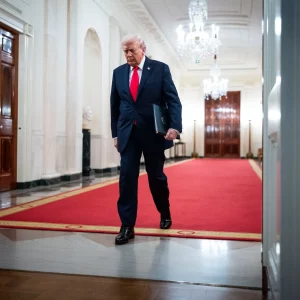
On October 28, at the first Japan-U.S. summit in Tokyo, Japanese Prime Minister Sanae Takaichi and U.S. President Donald Trump pledged to strengthen cooperation in defense and economic fields. Japanese media assessed that this commitment has opened a new chapter in bilateral relations.
Prime Minister Takaichi—who became Japan’s first female prime minister just last week—declared that she would work with Trump to build a new “golden era” for the Japan-U.S. alliance, while affirming that the bilateral relationship is currently “the greatest alliance in the world.”
Earlier, in a phone call with Trump on October 25, Takaichi stated that strengthening the bilateral alliance is the “top priority” of the Japanese government, while emphasizing Japan’s important role in the U.S. strategy toward China and the Indo-Pacific region.
For his part, President Trump affirmed that the two countries would have “a wonderful relationship” and that he “always holds great affection and respect for Japan.”
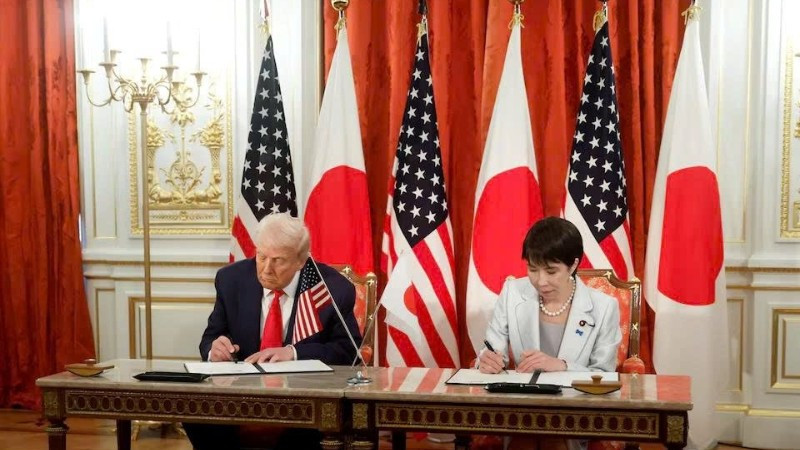
According to TTXVN reporters in Tokyo, the two leaders signed cooperation documents, including an agreement on securing and supplying critical minerals, including rare earths, to enhance economic security.
According to a White House statement, the two countries will coordinate the use of economic policy tools and investments in parallel to promote the development of diverse, transparent, and fair strategic mineral and rare earth markets.
On the security front, Takaichi and Trump affirmed the importance of strengthening the alliance’s deterrence and response capabilities.
Regarding Trump’s request for allies to increase defense spending, Takaichi pledged in a speech to the Diet last week to raise Japan’s defense spending to 2% of gross domestic product (GDP) by March 2026—two years earlier than the original target of fiscal year 2027. Japan has significantly increased its defense budget since setting the 2027 goal, amid the government’s revision of the National Security Strategy at the end of 2022.
The two leaders are also said to have reaffirmed the stable implementation of the trade agreement signed in July, under which Japan committed to investing $550 billion in key U.S. industries such as semiconductors, critical minerals, and shipbuilding, as well as increasing imports of U.S. agricultural products and goods. Based on this bilateral agreement, Trump reduced tariffs on Japanese goods, lowering the tariff on automobiles from 27.5% to 15%.
After the talks, Takaichi and Trump traveled by Marine One helicopter to the U.S. naval base in Yokosuka, southwest of Tokyo, where the two leaders will board the aircraft carrier George Washington.
The last time President Trump visited Japan was in 2019 to attend the G20 Summit in Osaka. Japan is the second stop in President Trump’s three-nation Asia tour, which began on October 24. Before arriving in Japan, he visited Malaysia to attend ASEAN summit meetings. His next stop will be South Korea, where he will attend the APEC Economic Leaders’ Meeting./.