Economists are holding up recent data pointing to a contraction in the U.S. economy as evidence that concerns over a recession caused by President Donald Trump‘s tariffs may be beginning to materialize.
According to the advanced U.S. GDP estimates, released by the Bureau of Economic Analysis (BEA) on Wednesday, the U.S. economy contracted by 0.3 percent year-on-year in the first quarter. This compares to an expected 0.3 percent increase, 2.4 percent growth last quarter, and marks the first decline in three years.
Why It Matters
As President Donald Trump has unveiled an expanding list of tariffs—many of them directed at China, the U.S.’ largest import partner—widespread concerns have emerged that these actions could result in higher prices for consumers while having a damaging impact on American businesses and the economy at large.
Economists told Newsweek that, while they were largely unsurprised by the data, it signals an unfortunate sign that the U.S. may be approaching, or has already entered, a significant economic downturn.
What To Know
“The decrease in real GDP in the first quarter primarily reflected an increase in imports, which are a subtraction in the calculation of GDP, and a decrease in government spending,” the BEA said in its release. “These movements were partly offset by increases in investment, consumer spending, and exports.”
According to Bill Adams, Chief Economist for Comerica Bank, the import surge was due to companies “front-running” tariffs, pulling forward their purchases before the new import duties take effect.
Imports were up 41.3 in the quarter, goods imports surging 50.9 percent at an annualized rate, which Adams told Newsweek was “the fastest on record in data going back to the 1940s.”
Peter Navarro, Trump’s senior trade adviser, brushed off any troubling implications of the data, calling it “the best negative print I have ever seen in my life.”
Navarro said that, if one discounted the negative effect of the rise in imports, the results would show a three percent growth in U.S. GDP, adding: “We really like where we are at now.”

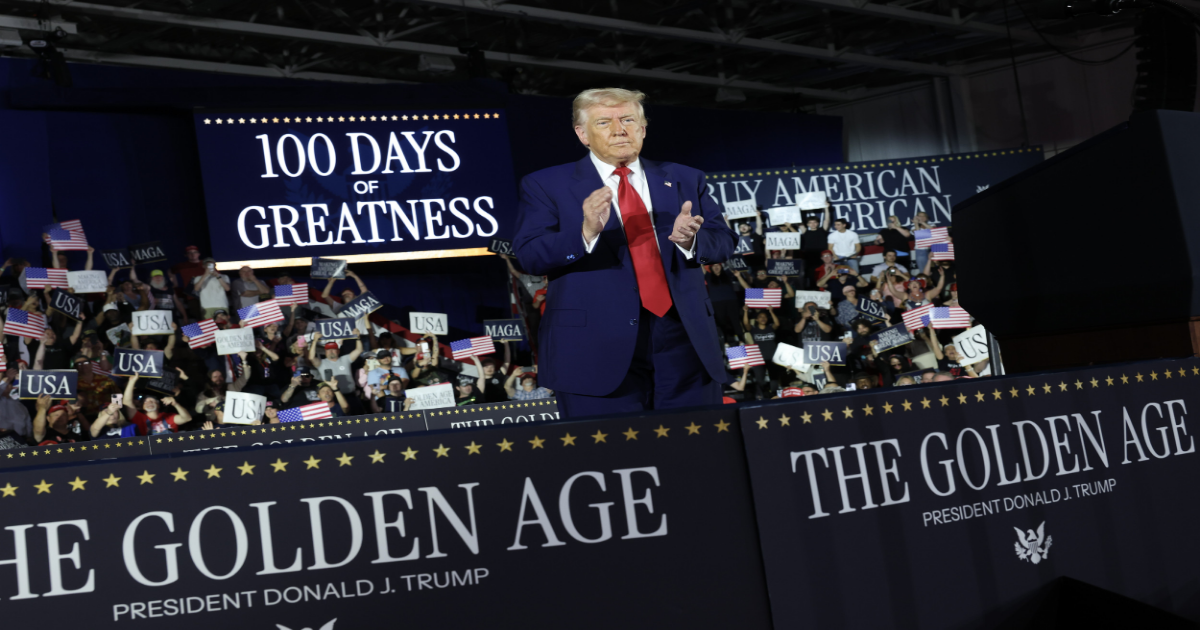
President Donald Trump speaks during a rally at Macomb Community College on April 29, 2025 at Warren, Michigan. President Donald Trump speaks during a rally at Macomb Community College on April 29, 2025 at Warren, Michigan. Scott Olson/Getty Images
Pushpin Singh, managing economist at the Centre for Economics and Business Research (CEBR), told Newsweek that “a deeper view of the BEA release shows that the surge in imports wiped 5 percentage points off real GDP growth.”
However, he added that other conclusions from the data—such as a slowdown in consumer spending growth—indicated a “cooling economy.”
“Our Country will boom, but we have to get rid of the Biden ‘Overhang,’ President Donald Trump posted to Truth Social following the release. “This will take a while, has NOTHING TO DO WITH TARIFFS, only that he left us with bad numbers, but when the boom begins, it will be like no other. BE PATIENT!!!”
What Economists Are Saying
Veronique De Rugy, political economist and senior research fellow at the Mercatus Center at George Mason University, told Newsweek: “This GDP contraction isn’t surprising—and no, tariffs aren’t solely to blame, but they’re a major part of the problem. The real issue is deeper: it’s the growing embrace of an erratic, nationalistic trade philosophy that treats allies like adversaries and assumes the U.S. can decouple from the world without cost. That’s economic fantasy.”
“This downturn is a flashing warning sign,” she added. “If we keep sabotaging the rules-based trading system and adding chaos to policymaking, economic pain will follow.
Jeffrey Roach, Chief Economist for LPL Financial, told Newsweek: “This morning’s growth estimate is eerily like Q1 2022, during the height of the supply chain problems. I don’t think this report provides much clarity to the growth trajectory.”
Nada Sanders, Distinguished Professor of Supply Chain Management at Northeastern University, told Newsweek: “The reality is that supply chains take time to shift and reverse course, reroute, ramp up and slow down. Impacts on supply chains and global trade take time manifest and even more time to reverse course.
“Right now, the numbers show a GDP that is unexpectedly weak given the massive imports—which is not a surprise,” Sanders said. “Fears of tariffs are looming and businesses and consumers alike are stocking up.”
“We still have to see what happens with policy and tariffs. There is time to reverse course,” she added. “However businesses I speak with are scaling back on capital investments. This weakening business sentiment—if continues—would mean a recession later in 2025.”
Thomas Sampson, Associate Professor in the Department of Economics at London School of Economics, told Newsweek: “The GDP estimates are clearly a cause for concern and show that President Donald Trump’s trade policy is already hitting the U.S. economy. That said, the impact of import stockpiling on measured GDP makes the numbers harder than usual to interpret so it will be important to see what happens in Q2.”
Wayne Winegarden, senior fellow in economics at the Pacific Research Institute, called the report “very disconcerting.” “The tariffs have encouraged people to move their consumption of imports into the first quarter, which dragged down GDP,” he told Newsweek. “Going forward a problem arises because, having spent the money now, it is likely that families will have to tighten their budgets during the second quarter. This creates a real risk that consumption will drag down GDP growth next quarter.”
“The risk to the economy grows next quarter should business investment also falter, which is a growing risk from the tariffs,” he added.
Pushpin Singh, managing economist at the CEBR, told Newsweek: “Bottom line here is that the latest figures don’t materially shift our view on recession risks, as this was in line with our view. While the Q1 contraction reflects a sharp rise in imports ahead of the April tariff announcement (and this could be directly attributed to tariffs), this represents a front-loaded trade distortion. Indeed, a deeper view of the BEA release shows that the surge in imports wiped 5 percentage points off real GDP growth. That said, softer consumer spending points to a cooling economy, and if seeps into further quarters, the odds of a recession will likely go up.”
Paul De Grauwe, Political Economy professor at the London School of Economics, told Newsweek: “It’s true that much of the sharp decline in GDP growth during the first quarter is due to the import surge in anticipation of tariffs. And that’s a temporary effect. Whether the economy will bounce back will depend on what consumers and firms do. Consumers have a negative outlook now and, if maintained, consumer spending will drop. Similarly firms feel very uncertain because of the frequent U-turns of the Trump-administration and they are likely to postpone investment. Put differently the increase in risk due to volatile behavior of the Trump administration is likely to reduce spending on consumption and investment goods. If this is a good prediction then we will see further declines in GDP.”
Gary Hufbauer, senior fellow at the Peterson Institute for International Economics, said that while the latest contraction is “largely explained by the import surge,” he does not anticipate a “bounce back” in the second quarter.
“There’s too much negative consumer sentiment and business uncertainty for an economic revival,” he told Newsweek. “Quite possibly, the 2025 recession started in Q1, earlier than I expected.”
What Happens Next?
A recession is conventionally defined as two quarters of negative GDP growth, meaning it may take some time before there is consensus around the state of the U.S. economy. Following the advance estimate, a second assessment for first-quarter GDP will be released by the BEA in late May.